Practical guide to Taiwan - how to plan your trip

I recently visited Taiwan, and fell in love madly and deeply! In this post, you will find all the practical information you might need to plan your trip and to explore this wonderful country on your own. If you want to learn more about Taiwan, craft your perfect itinerary, I have several posts from my trip that you can find on my blog!
Taiwan is an incredibly well-organized destination. It’s easy to navigate (and Google Maps works great here!), well-connected via public transport, safe to explore as a tourist and full of hidden gems and under appreciated views. I truly believe it will pop up in the next couple of years as a must-see destination, so I recommend visiting now!
Language
The main language used in Taiwan is mandarin, with a traditional character spelling. That’s one of the differences between Taiwan and continental China, where simplified characters are used. Many Taiwanese people speak Taiwanese - a dialect more native to the land, deriving from the Hokkien dialect of Chinese. The languages are quite different, especially in sound. When it comes to English, it’s popular but don’t expect to be greeted with it from the get go. Some people, mostly from the younger generation, speak English fluently, however it’s not a given, and personally I encountered a few situations during my trip where the only common language we knew was the language of gestures and smiles. However, the people are so kind and helpful that it was never a problem and we could communicate with ease.
Currency & exchanging money
The official currency in Taiwan is New Taiwan Dollar (NTD) and when I’m writing this article, the exchange rate is 1 USD =~ 32 NTD, or 1 EUR =~ 37 NTD. You can easily exchange money both at the airport and in cities. I recommend exchanging money in official banks, like the Bank of Taiwan, since they have good exchange rates and don’t take provision. It’s also convenient to withdraw money from official ATMs - most of them also have no fee. You may need cash in smaller towns, local shops and especially on night markets, but overall, it’s more and more popular to opt for cashless transactions. You can pay with your credit card almost everywhere. Another convenient option is registering for Line Pay. Line is a messaging app widely common in Taiwan and you can register there with a Taiwanese phone number. It can also be used as a payment app and it was available almost everywhere where credit cards were not accepted.
Climate
The climate of Taiwan can be generally characterized as subtropical, with the northern part cooler and more humid, and the south dry and sunny. The weather is seasonal, and if I were to recommend a season to visit, for me personally early spring is the best moment. That was when I visited and the weather was perfect - not too cold, and not too hot, around 10-20 degrees Celsius and watching the flowers blooming everywhere was truly a highlight. However, I can only imagine how beautiful the country can be in full bloom, or in a more moody, rainy atmosphere.
Culture and religion
People in Taiwan are hospitable, helpful and welcoming. They are proud of their land and culture, and love to share it with respectful tourists. It is in good manners to learn a few phrases in Mandarin, like hello or thank you - believe me, it will go a long way. From my experience, people here are rather shy and quiet, I haven’t encountered any aggressive or loud behaviors. The main religion in Taiwan is Taoism, which promotes a tranquil way of living. The temples are beautiful, rich in colors, flowers and golden statues. I recommend visiting a few and donating to keep them open and safe - and always remember to respect the sanctity of places like this and wearing appropriate clothing. Other religions in Taiwan are Buddhism and Christianity and you can find churches and temples all around the country.
Safety
Taiwan is known as one of the most progressive countries in Asia. It was the first one in Asia to legalize same-sex marriage, for example, and there are pride parades regularly organized in Taipei. As a woman, I felt very safe walking in the city and in less crowded areas. The people were kind, helpful and I never encountered dangerous situations. Pickpocketing is present, but not common and from what I’ve heard, because happily I haven’t experienced this firsthand, most of the lost items are not stolen, and instead taken to the nearest convenience store or a police station.
As a pedestrian, I also felt quite safe, as the cars were usually stopping to let the pedestrians go and the general culture of driving was quite relaxed in comparison to other Asian countries I’ve visited. Of course, anything can happen, so please always take care of yourself and pay attention to your surroundings.
Something worth addressing is the political situation of Taiwan, which is a topic for a broad article, preferably written by someone with broader knowledge on political and international affairs than myself. However, as a tourist, I did feel safe. There are occasional sounds from training air force, mostly in the southwest of Taiwan, but for me personally, it wasn’t disturbing. So, if you’re wondering whether it’s safe to travel to Taiwan because of its standing with continental China, I’d say to go as soon as possible. There’s never a sure way to predict the future, but as for now, as a foreign tourist, I felt safe.
Food and drinks
The food culture in Taiwan is huge and I have a whole separate post on all my recommendations on what to try to eat and drink on your trip. My favorite form of enjoying food was during the night markets - available both in big cities, and in smaller towns. I was also surprised to see how fun these night markets are in Taiwan! I was familiar with the concept from Thailand or Malaysia, but the night markets in Taiwan are a whole other level. Not only do you get a plethora of food stalls with local cuisine, as well as international treats (the most popular cuisine was definitely Japanese!), but also a huge selection of games and attractions. Once you’re done with your meal, you can play on marble machines, throw some basketballs and win stuffed animals, or even try your luck in a ring toss, where you can win anything from toys to beer. Taiwan is also known to be a birthplace of bubble tea - and you can see it on every corner. My favorite thing was to stay in a line to a bubble tea chain store like 50len or ComeBuyTea with a bunch of teenagers after school and indulging in a milk tea with chewy boba. Yum!
If there’s something you should definitely try in Taiwan, it is a properly brewed oolong tea. There are many tea houses in all of Taiwan, where the nicest people will show you how exactly this ritual should be celebrated.
Getting around Taiwan
Something I truly appreciate while traveling is how convenient it is to use public transportation during a trip. I love spending time on trains and long-haul bus rides. There’s just something really magical in boarding the train and taking in the views, or even talking to strangers. It also allows me to slow down in my travels, appreciate the surroundings and relax on board with a book or my travel diary. Having travelled in Taiwan via buses, different types of trains and even renting a car, I can honestly say that it was one of my favorite countries to travel around.
It’s incredibly easy to travel across Taiwan. The public transportation here is top notch, both in the cities and around the country. Upon arrival, I recommend getting an EasyCard or iPass in any convenience store, like 7-eleven or Family Mart. It can come is a shape of a regular card, but there are many super cute designs from shows and games like Pokémon, Winnie the Pooh, and many others. You can also get a special “card” which can be shaped like a keychain, or even a toy. It’s really cure and easy to use - you just top it up either at a store, or a metro station, and use it as a transportation card all around Taiwan. Just tap in on as you enter and then exit a bus or metro station. It’s also accepted on city ferries, like in Kaohsiung and can be used to rent city bikes. You can also use it to pay in some stores!
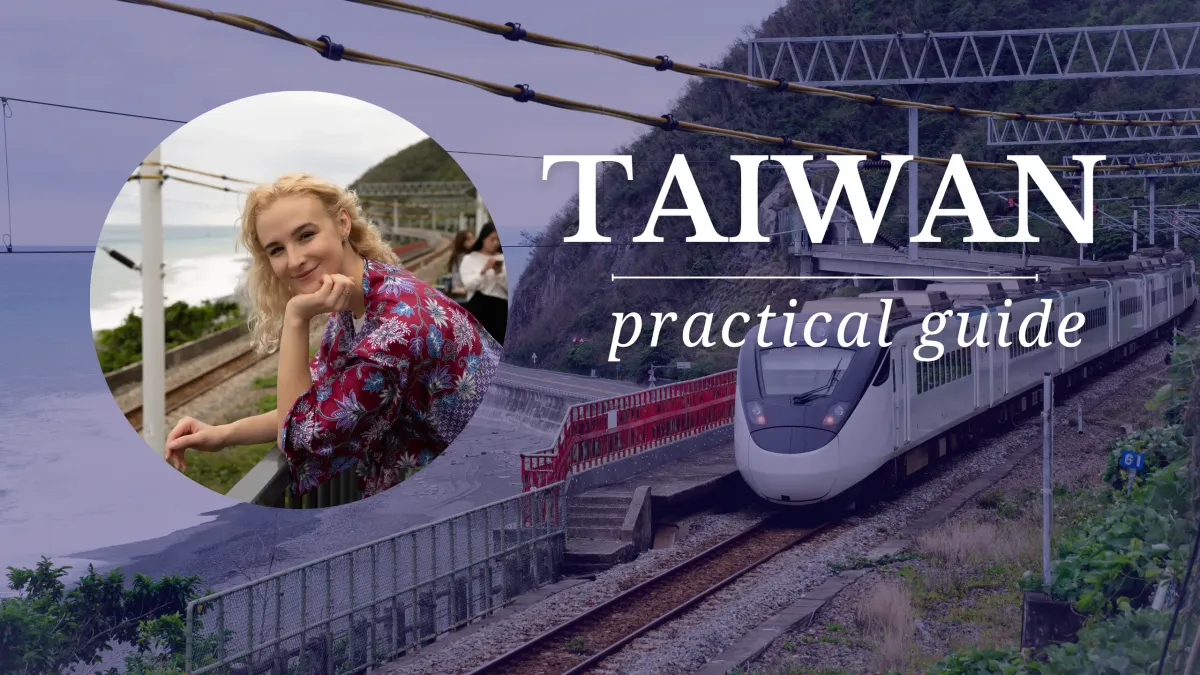
As for the rail travel in Taiwan, there are 3 types of trains you can choose from. There are local trains cruising mostly within regions. They are cheap, reliable and you can buy tickets either online, or at a train station. You don’t usually reserve seats for these trains. The second option are regional trains, TR. You can buy tickets and reserve seats online or at the train station. They connect the entire island, so you can travel wherever you want. They are comfortable, in my experience on time, and as a bonus, on longer rides you can buy lunch - a signature TR bento box for ~100 NTD to be delivered to your seat. I mostly opted for these trains during my trip. And last but not least, you can also try out the High Speed Rail (HSR) which connect the north (Taipei) with the south (Kaohsiung). The tickets are slightly on a pricier side, but still manageable especially when buying in advance via website (you can get even 20% off). They are incredibly fast, going around 300 km/h, so I recommend booking at least once for the experience.
It’s also quite easy to rent a car and do a roadtrip, especially on the east coast. But you can read about that more in my East Coast guide, where I go into details on how to rent a car.
Useful apps and websites
Recently, I’ve been using e-SIM cards and I can recommend an app called Nomad for this purpose. It’s worked great in the last couple of places I visited, including Taiwan. However, with a Taiwanese phone number, it is easier to rent a city bike or register for Line, so this is something I would do for at least one phone per group.
My other recommendation is a platform called Klook. You can use it to rent a car, book trips, experiences, tickets and even hotels. They often have competitive offers and the interface is easy to navigate.
For my hotel bookings, I used Agoda - they offer a wide selection and I’ve found that it’s much more popular in Asia than, for example, Booking. com.
And as for inspiration and info on traveling in Taiwan, I cannot recommend the blog: TaiwanObsessed enough. I used this blog almost everyday while planning my trip. Anything you might want to find out about Taiwan, you can find in here, from guides and itineraries, to step-by-step guides on how to buy tickets on websites available only in Chinese. One of my favourite blogs I’ve found in recent years!
I hope you're falling more and more in love with Taiwan, just like me. Let me know if you've visited Taiwan and what are your practical tips to traveling this country!
See you next time,
Adriana